Close

Water is an important resource for maintaining people's lives and health. Good quality water is essential for us to create innovative pharmaceuticals and ensure stable supply of these pharmaceuticals to patients. We are committed to minimizing the negative impacts of our operations on the global environment and achieving a sustainable water recycling society through the efficient use of water, appropriately wastewater management, and enhanced stakeholder engagement.
As for water risks, the Environmental Management Committee and the Nature Positive Subcommittee (previously: Water Subcommittee) take the lead in identifying the risks that are considered to have negative impacts on our business and in considering countermeasures to mitigate those risks.
In addition, in FY2024 we reviewed water-related risks and disclosed information in line with the recommendations of the Task Force on Nature-related Financial Disclosures (TNFD). For more details, please see the page of our website titled “Information Disclosure Based on the TNFD Recommendations.”
| Water stress | Sites |
|---|---|
| Low to medium risk | Yamaguchi Plant, Joto Pharmaceutical Product Development Center, Minase Research Institute |
| Medium to high risk | Fujiyama Plant, Tsukuba Research Institute |
| High or extremely high risk | Not applicable |
| FY2025 Company-wide water targets and initiatives | |
|---|---|
|
|
| FY2025 Water withdrawal reduction plan | |
| Fujiyama Plant | Reduction of water withdrawal through the optimization of pharmaceutical water system operations, etc. |
| Yamaguchi Plant | Reuse of condensate generated in piping during steam distribution from boilers to manufacturing processes Evaluation of water-saving effects through optimization of vial washing machine operations, etc. |
| Minase Research Institute | Evaluation of water-saving effects through replacement of air-conditioning humidifiers and spray nozzles, etc. |
| Tsukuba Research Institute | Evaluation of water-saving effects through reducing the number of operating boilers, etc. |
| Water shortage risk |
|
|---|---|
| Water pollution risk |
|
| Supply chain risk |
|
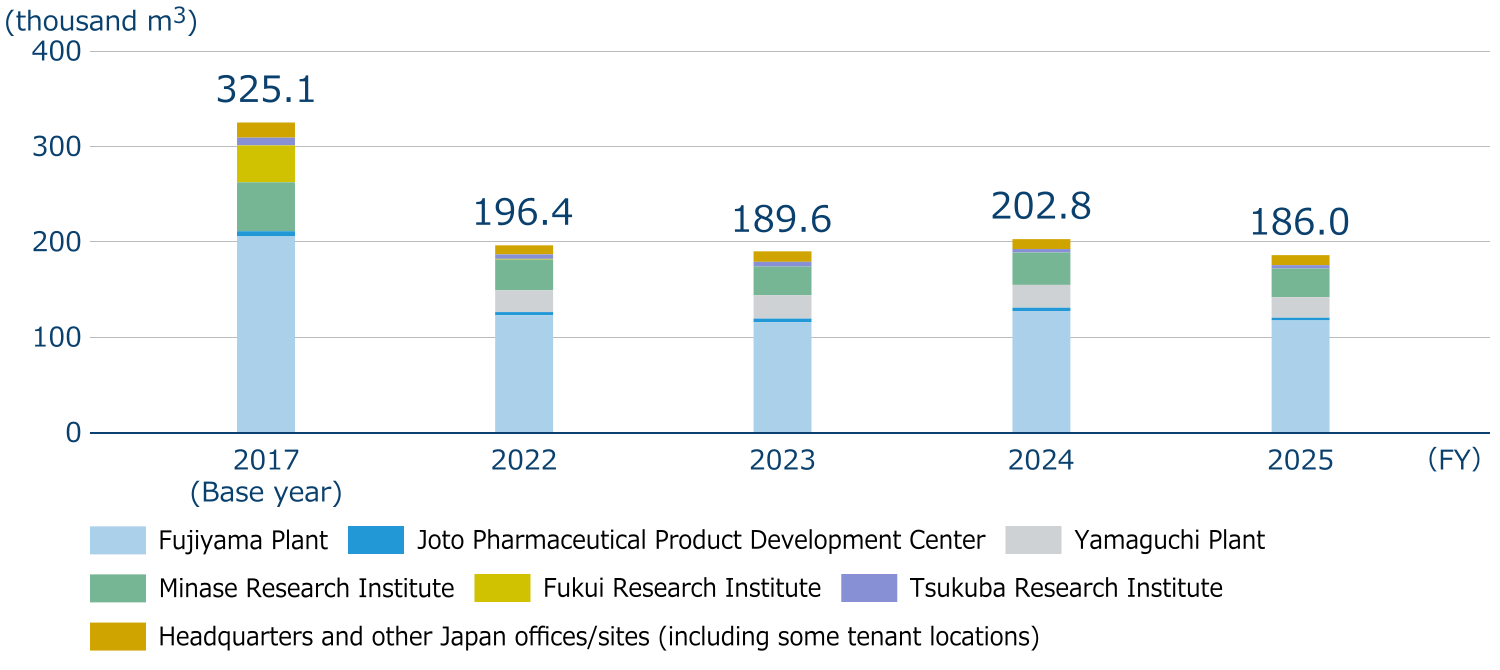
The total water withdrawal in FY2025 was 186.0 thousand m3, a reduction of 16.8 thousand m3 (reduction rate: 8.3%) compared to FY2024. Furthermore, compared to the base year (FY2017), water withdrawal in FY2025 was reduced by 139.1 thousand m3 (reduction rate: 42.8%), indicating steady progress toward achieving our medium- to long-term environmental targets.
Specific initiatives to reduce water use have included improving the operation of equipment with high water use identified by installing flow meters at plants and research institutes (reviewing blowdown time in pharmaceutical water systems, optimization of the water levels and sterilization processes in pharmaceutical and injection water tanks, discontinuation of water spraying to air-cooling chillers, and changing the activation temperature settings for water spraying, etc.), reducing cooling water by recovering heat from hot wastewater tanks and high-temperature wastewater, upgrading to high-efficiency boilers, reusing condensate from air conditioning systems, and conducting regular leak inspections. In addition, as a company-wide initiative, we have established a subcommittee on water to discuss new initiatives at each site to reduce water usage and to promote activities that raise employees’ awareness of water conservation.
Water use (water withdrawal)
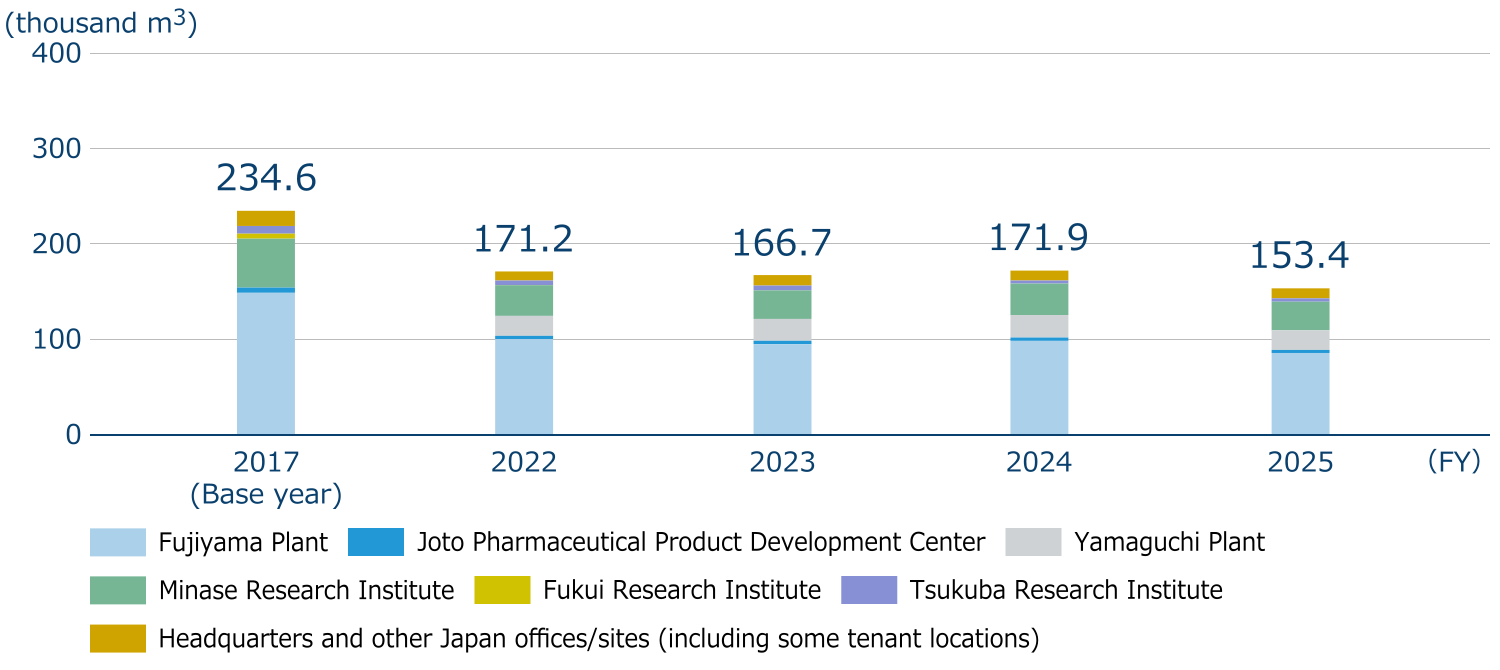
Water discharge
There is growing public concern about the ecosystem impacts of active pharmaceutical ingredients released into the environment. We are taking measures to prevent the release of active pharmaceutical ingredients and other relevant substances into the environment during the manufacturing process of pharmaceuticals. For more details, please see the page of our website titled “Biodiversity.” Since FY2022, we have been conducting Whole Effluent Toxicity (WET) tests annually at our Fujiyama Plant, which is our major production center. In FY2024, WET tests were conducted at three sites: the Fujiyama Plant, Yamaguchi Plant, and Tsukuba Research Institute. Beginning in FY2025, WET tests were expanded to cover all of our manufacturing plants and research institutes (a total of five sites). We will continue to conduct WET tests on an annual basis and use the results to ensure the appropriate management of wastewater from our plants and research institutes.
For active ingredients of development compounds and of pharmaceuticals, we will not only predict environmental hazards using in silico quantitative structure-activity relationship (QSAR) analysis but will also evaluate the effects on aquatic organisms, and these results will be disclosed through safety data sheets (SDS).
| Item | Scope | Unit | FY2022 | FY2023 | FY2024 | FY2025 |
|---|---|---|---|---|---|---|
| Number of breaches of legal obligation/regulatory violations | All operation sites | Cases | 0 | 0 | 0 | 0 |
| Amount of breach-/violation-related fines | All operation sites | Million yen | 0 | 0 | 0 | 0 |
| Environmental liabilities as of fiscal year-end | All operation sites | Million yen | 0 | 0 | 0 | 0 |
We are reviewing our medium- to long-term environmental targets, which currently cover Ono Pharmaceutical Co., Ltd. only. By FY2027, we aim to establish and publicly disclose global water-related targets applicable to the entire ONO Group.
In the Water Security survey conducted by CDP, a global environmental non-profit organization, we have been selected “A List” company, the highest rating, for five consecutive years (FY2021 to FY2025).