Close

In all its business activities in and outside Japan, the ONO Group understands and respects the human rights of each individual in terms of diversity of values, personalities, and characteristics, and we act accordingly. At Ono, we also uphold and respect the International Bill of Human Rights, the ILO Declaration on Fundamental Principles and Rights at Work, conventions on the human rights of workers, such as wages and working hours, etc., the OECD Guidelines for Multinational Enterprises, the United Nations Declaration on the Rights of Indigenous Peoples, and other international codes of conduct related to human rights, and the Ten Principles of the United Nations Global Compact.
In July 2020, we established the Human Rights Global Policy based on the United Nations Guiding Principles on Business and Human Rights. In order for the ONO Group to fulfill its responsibility to respect the human rights of its stakeholders, we apply this Human Rights Global Policy to all executive officers and employees of the ONO Group, and we also encourage all of our business partners involved in the businesses, products, and services of the ONO Group to comply with the policy. This policy has been revised and was disclosed after obtaining the approval of the Board of Directors meeting held in March 2023.
We also consider that respect for human rights by employees is a foundation of business activities, and thus included respect for human rights in the ONO Group Code of Conduct, which all the group’s employees should follow as a guideline in their daily operational activities.
In addition, considering further development of our global business activities, we have revised the Procurement Activities Basic Policy and established the Sustainable Procurement Code for ONO's Business Partners in which we explain the matters concerning global human rights issues, such as forced labor and child labor, for which we need cooperation from our business partners throughout the entire supply chain. With these, we are requesting cooperation of our business partners and strengthening collaboration with them.
In the ONO Group, we recognize that we may have adverse impacts on human rights directly or indirectly through our business activities. In accordance with the United Nations Guiding Principles on Business and Human Rights, we have established a human rights due diligence system to prevent or reduce adverse impacts on human rights that ONO Group’s business activities may have in society. We continue to implement the system and externally disclose the results as well as its progress.
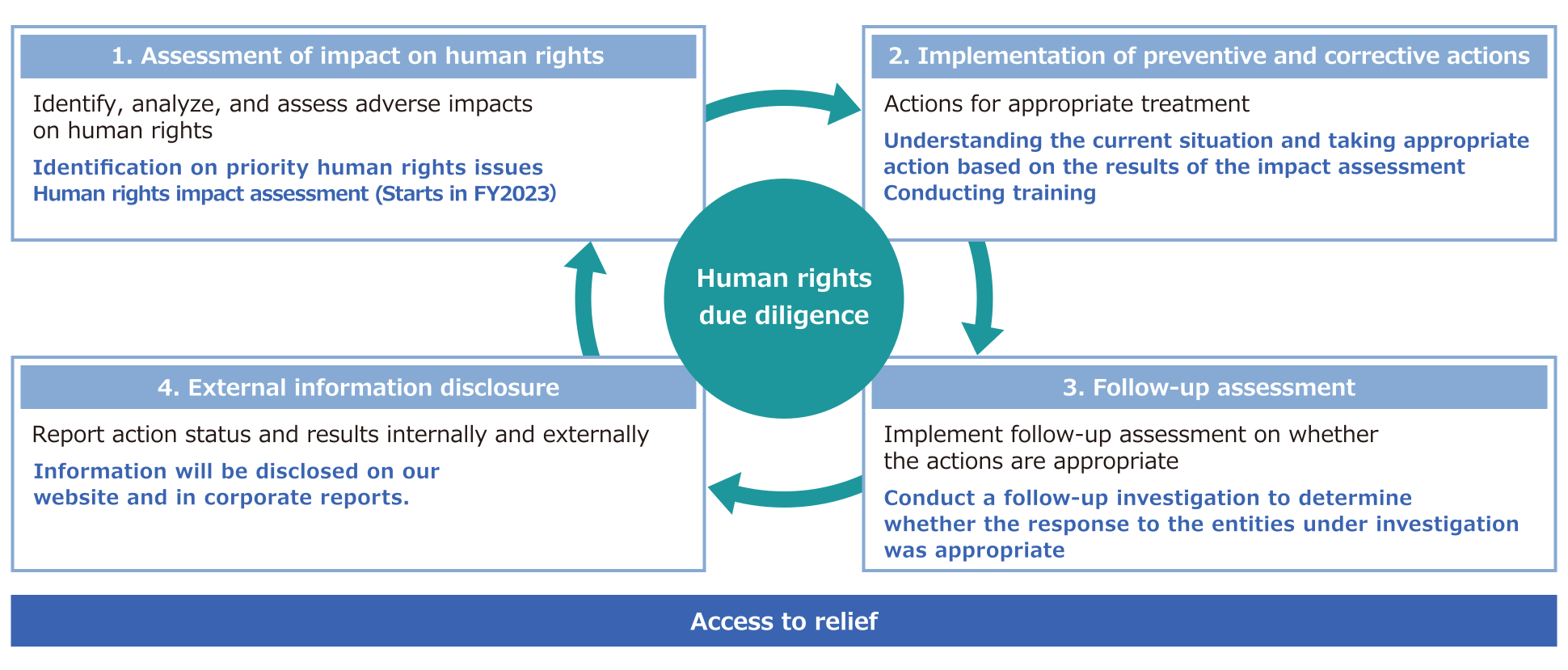
We conducted an impact assessment of potential risks to human rights (human rights risk assessment) in the ONO Group and our value chain in collaboration with the Caux Round Table (CRT Japan Committee) and specified priority human rights issues to address intensively.
To identify these themes, we first conducted a desktop survey* to extract potential human rights risks associated with the ONO Group’s business activities throughout our value chain.
In addition, we held a two-day human rights due diligence workshop with 25 participants in total from relevant departments to find out issues and areas with high potential human rights risks and to identify the ONO Group’s risks.
In the workshop, we considered social requirements and changes, and listed out potential human rights risks that may have impacts on the ONO Group’s business and that may occur among rights holders or anywhere in the value chain.
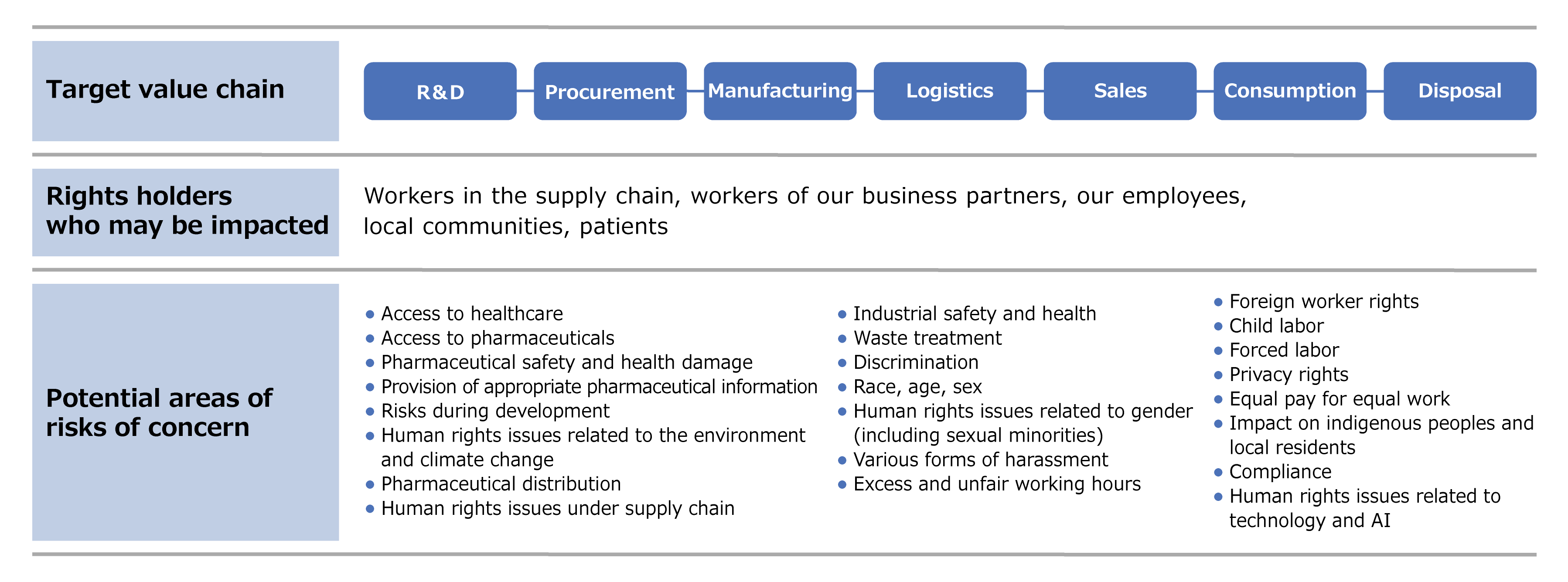
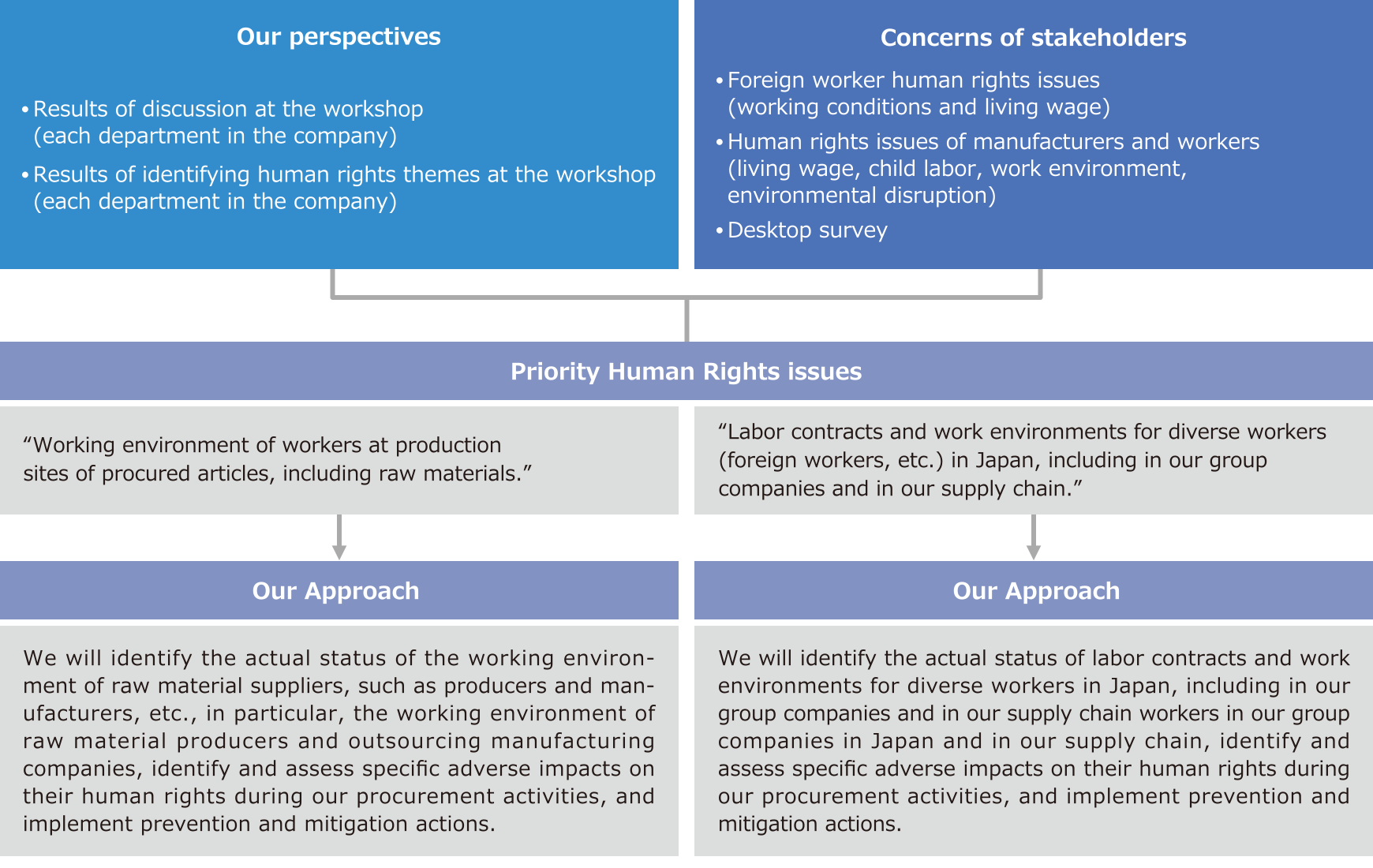
As a result of the assessment we conducted on the potential human rights risks that are of concern identified through the desktop survey and the human rights due diligence workshop, it turned out that there were some issues for which the details were not known to us. We are currently working together with our group companies and business partners to grasp the actual status regarding the two issues mentioned below. In addition, while implementing preventive and corrective actions as necessary, we are also working to establish a system in which high priority human rights issues and potential future human rights issues can be promptly recognized.
As part of our efforts to promote respect for human rights among our business partners, we use the “Ono Pharmaceutical Sustainable Procurement Code for Business Partners”—which summarizes the matters for which we request our business partners’ cooperation—to solicit cooperation and strengthen collaboration. For key business partners, we obtain written consent and request that they undergo risk assessments, such as those conducted by EcoVadis, to verify the status of their sustainability, including human rights. In addition, for business partners whose risk assessment scores fall below our standards, we verify their actual conditions through on-site audits and other means, engage in dialogue with them, and provide support to help them make corrections and improvements.
Please click here for more information.
Furthermore, based on the identified human rights issues, we checked the status regarding labor contracts and work environments for diverse workers in the supply chain. In particular, we focused on packaging-related suppliers who are likely to employ foreign workers using Japan's foreign technical intern training system, and conducted a survey.
| Human Rights Issue | FY2022 | FY2023 | FY2024 | FY2025 | Future Initiatives |
|---|---|---|---|---|---|
| [Labor contracts and work environments for diverse domestic workers, including group companies and supply chain (e.g., foreign workers)] Checked Industry (Packaging) |
― | We conducted a survey of each of the printing companies who are our major suppliers to check the actual status of foreign workers. At one of the companies, we interviewed the managers/supervisors of technical intern trainees with the cooperation of the CRT Japan Committee to confirm the employment status, as well as the status of respect for human rights of technical intern trainees. As a result, we confirmed that there were no negative impacts on the human rights of technical intern trainees at that company. | We conducted a survey of several suppliers of direct materials related to packaging to check the actual status of foreign workers. At one of the companies, we interviewed six technical intern trainees with the cooperation of the CRT Japan Committee to confirm the employment status, as well as the status of respect for human rights of technical intern trainees. As a result, we confirmed that there were no major concerns regarding the respect for human rights of technical intern trainees. | We confirmed that measures had been implemented to also address the employment-related concerns raised by technical intern trainees interviewed in FY2024. In addition, we considered measures for FY2026 and beyond to address the identified human rights issues. |
Continue to confirm, in cooperation with suppliers, whether any negative impacts have occurred in accordance with the human rights issues. |
While encouraging each employee to deepen their understanding and acquire correct knowledge regarding human rights, we are striving to create comfortable work environments through training on human rights awareness and other various programs for all the employees aiming to prevent human rights violations including various forms of harassment.
Please click here for more information on our efforts against harassment.
We have established a system to take action promptly for high priority human rights issues in cooperation with CRT Japan Committee.
In 2022, Kimberly-Clark Corp (U.S. company) and Ansell Ltd (Australian company) were sued by International Rights Advocates (IRA), a legal support group in Washington, D.C., on the grounds that the abovementioned companies knowingly profited from forced labor at Brightway Holdings, a rubber glove manufacturer and supplier in Malaysia.
| Response to forced labor confirmation | FY2022 | FY2023 | FY2024 | FY2025 | Future Initiatives |
|---|---|---|---|---|---|
| Work environments for workers at production sites for procured goods, including raw materials | We conducted an investigation through our agents. As a result, we confirmed that, as of the investigation date (September 15), Kimberly-Clark had discontinued transactions with Brightway, had no longer handled Brightway's products, and is conducting third-party audits regularly with all their outsourcing manufacturing companies. We determined that we would continue to use the products of Kimberly-Clark while watching the progress of the lawsuit and their actions, and if further concerns arise in the future, we will reexamine transactions with Kimberly-Clark and may also consider the possibility of using substitutes. | Continue to watch closely. | Continue to watch closely. | Continue to watch closely. | We will continue to monitor the situation, and if further concerns arise in the future, we will reexamine the use of substitutes. |
We have established internal and external points of contact for reporting to prevent the occurrence and recurrence of compliance violations, including harassment, to secure an appropriate work environment, and to minimize loss and the erosion of public trust by taking swift action and measures in the event of a violation. The external contact point, "ONO Group Compliance Hotline," is available 24 hours a day and can be used by all ONO Group officers and employees, as well as external parties, in multiple languages. Additionally, we have established a system that enables direct reporting and consultation with management, including the Representative Director, President & COO, the Officer in Charge of Compliance, and the Audit & Supervisory Board Member.
The Risk & Compliance Management Department investigates any violations that occur. As a result, those who are found to have violated compliance are subject to disciplinary action, including termination of employment. We are also working to prevent recurrences by strengthening our compliance management system and thoroughly raising employee awareness through training, etc. Please refer to the ESG data for the number of violations.
For details on the reporting system, please see here.