Close

Satoshi Takahagi
Senior Director, Sustainability Promotion as Corporate Officer
Director in Charge of Sustainability & Executive Director in Charge of the Environment
Satoshi Takahagi
Senior Director, Sustainability Promotion as Corporate Officer
Director in Charge of Sustainability & Executive Director in Charge of the Environment
Our business is closely linked to the global environment at every stage—from research and production to transportation, use, and disposal. In particular, ensuring the quality of pharmaceuticals and maintaining a stable supply requires a steady supply of raw materials, water resources, and energy—all of which are dependent on changes in the global environment, such as climate change and resource constraints. Water resource constraints and fluctuations in water quality affect the stability of manufacturing processes and quality control, while instability in the supply of raw materials and fluctuations in energy supply impact production plans and supply systems.
Far beyond being simple external risks, environmental issues represent a core business foundation element that directly impacts the quality and supply stability of pharmaceuticals, which is why we have designated “Global Environmental Preservation” as one of our materialities.
Rather than viewing environmental issues merely as risks, we regard them as opportunities to create innovation and improve corporate value over the medium to long term. Through advances in technologies and processes that help reduce environmental impact, we aim to support the provision of sustainable healthcare and become a leading environmental company in the pharmaceutical industry.
To achieve this, we have identified the “Realization of a Decarbonized Society,” “Realization of a Water Recycling Society,” and “Realization of a Resource Recycling Society” as priority areas, and are working to visualize and reduce environmental impact across our entire value chain. By incorporating these initiatives into our business activities and reducing our impact on the environment, we aim to strengthen our stable supply system and improve our ability to comply with regulations, thereby achieving sustainable growth in our corporate value over the medium to long term.
Various global environmental issues, including abnormal weather patterns, are becoming more serious year by year, and efforts to protect the environment have become a key issue for the international community. The ONO Group recognizes its corporate social responsibility for the environment, and under our Global Environment Policy, we promote environmentally conscious initiatives in all areas of our business activities to pass on a prosperous and sustainable global environment to future generations.
In 2019, to realize a sustainable society, we formulated our medium- to long-term environmental vision for 2050, named “Environment Challenging Ono Vision (ECO VISION 2050).”
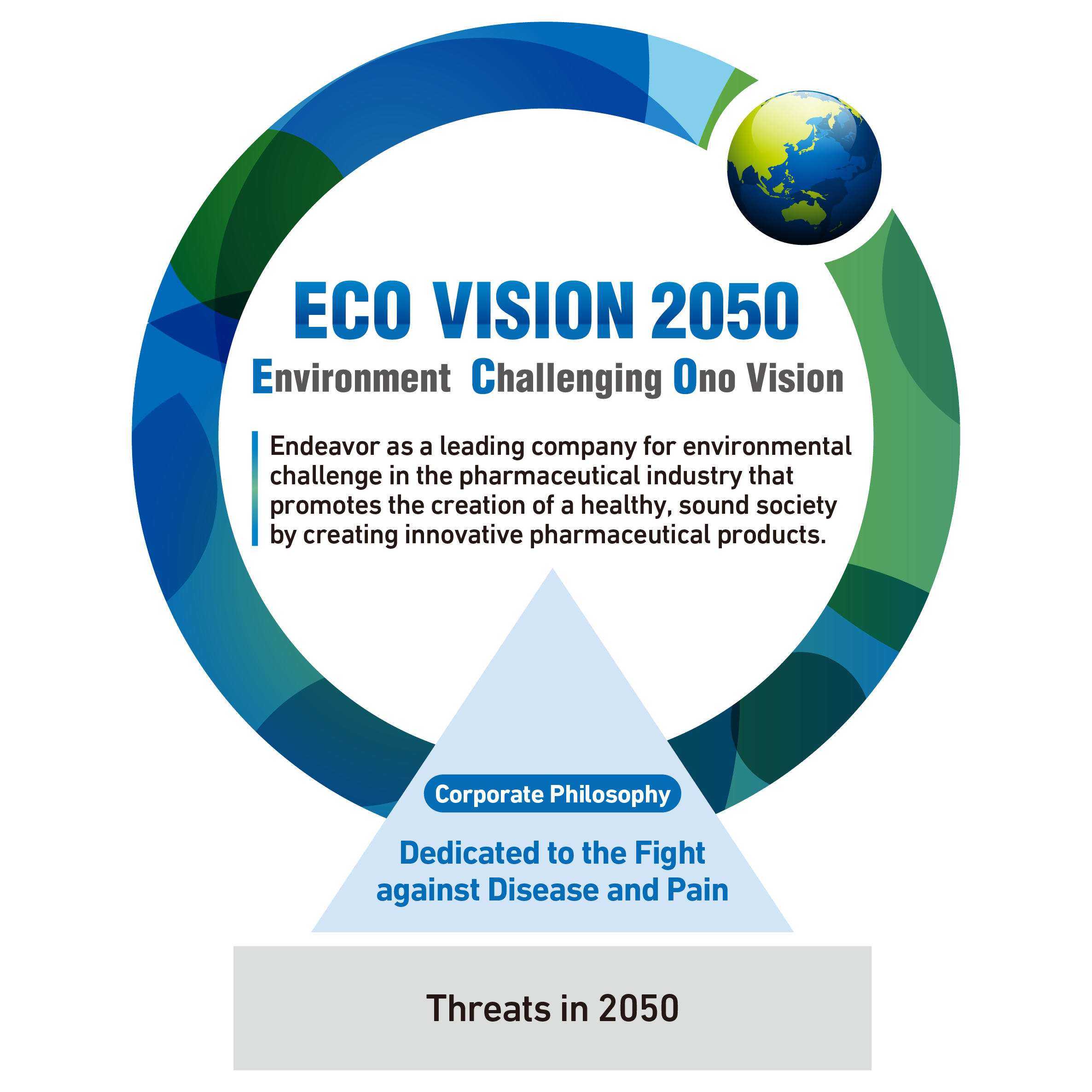
In recent years, global environmental issues such as climate change have become increasingly serious. In the future, by 2050, it is expected that people’s healthy and sound lives will be threatened by various risks, such as shortages of water and food, an increase in new diseases, and the destruction of the infrastructure that supports daily life due to more severe natural disasters.
Under our corporate philosophy, “Dedicated to the Fight against Disease and Pain,” we believe that, in order to continue promoting the creation of a healthy and sound society through the development of innovative pharmaceutical products, it is important to recognize that our business activities are supported by a sound global environment and to strengthen our efforts to address environmental challenges. We believe that these efforts are not only our corporate responsibility for the environment, but also help build the foundation for sustainable business activities.
To help realize a healthy and sound society, we will take on the challenge of reducing our environmental burden toward 2050, based on ECO VISION 2050.
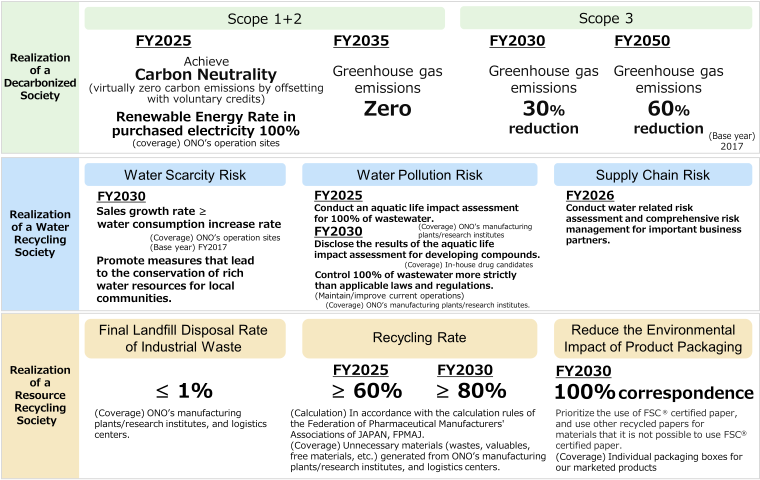
Based on our medium- to long-term environmental vision, ECO VISION 2050, we have set targets and have been working toward the realization of a decarbonized society, a water recycling society, and a resource recycling society. In order to further strengthen and accelerate our efforts to address global environmental issues, we have updated our medium- to long-term environmental targets from 2023 and are promoting activities to achieve these targets.

To help employees feel a personal connection to global environmental issues and encourage individual action, the ONO Group conducts environment-related education and awareness-raising activities for all employees.
Company-wide, we regularly share information on environmental issues through our internal SNS and other channels, and post easy-to-implement energy-saving tips related to lighting and air conditioning to help reduce unnecessary energy use.
At each site, we also strive to raise employees’ environmental awareness. For example, at the Minase Research Institute and Head Office, which are equipped with solar power systems, monitors displaying generated energy are installed at employee entrances. At the Joto Product Development Center, lists of equipment with high energy usage are shared with researchers. At the Yamaguchi Plant, we have declared our participation in the “2050 Zero Carbon Challenge – Buchi Eco Yamaguchi Prefectural Movement” promoted by Yamaguchi Prefecture, and are actively engaged in energy-saving activities. In addition, as part of our efforts to address social issues related to global warming and other concerns in Yamaguchi Prefecture, we completed our registration in June 2025 as a “Yamaguchi Ethical Promotion Partner,” a program aimed at businesses and other entities actively engaged in ethical consumption. We promote these activities in collaboration with local communities while fostering employee awareness.
In addition to these activities, at the Fujiyama Plant and Yamaguchi Plant, we conduct annual environmental education and training for all employees at each plant. In FY2025, we thoroughly communicated our Global Environment Policy and Medium- to Long-term Environmental Targets to all employees, and provided education and training on the plant’s internal management system and activities for environmental targets set for the entire plant and for each organizational unit. Each plant is taking its own approach to raise environmental awareness among employees.
Furthermore, the Environmental Committee, which meets monthly at each plant, confirms and discusses matters such as revisions to laws and regulations, changes to environmental management systems, and reports on environmental activities conducted by each organization, and we have established a system whereby the contents of such confirmations and discussions are shared by the Environmental Committee members with all employees at each plant.
Moreover, the CMC and Production Division, to which employees of both plants also belong, holds annual e-learning courses on “waste separation rules” and “hazardous materials management,” and more than 90% of employees have taken the courses.
At the Minase Research Institute and Tsukuba Research Institute, annual group training and monthly e-learning sessions on various topics are provided for research employees. Topics include chemical substance management (toxic, deleterious, and hazardous substances), biosafety management (pathogens, genetically modified organisms, etc.), wastewater management from experiments, and waste separation rules. All relevant employees are required to participate in the group training. Through these educational efforts, we strive to prevent soil and water pollution.
Employees responsible for environmental activities actively participate in exhibitions and seminars related to the environment to acquire the latest knowledge and trends, which are then shared internally. This helps to enhance the company’s overall environmental performance.
To address natural environmental issues, including climate change, we are accelerating our efforts to reduce our environmental impact by participating in initiatives and industry group committee activities that align with our company’s philosophy and direction, and by working to lobby the government through industry groups. When participating in such initiatives, we consider consistency with our business objectives, focus areas, and business activities, and regularly examine whether there are any major contradictions between industry associations and our approach to environmental conservation.
If there is a large discrepancy, we even consider withdrawing from the initiative, etc. The environment-related initiatives that we participate in are as follows:
Our greenhouse gas reduction targets were certified by the SBTi in June 2019.
The SBTi is an initiative that supports and certifies companies to set science-based targets.
We expressed our support for the TCFD recommendations in October 2019 and joined the TCFD Consortium at the same time. The TCFD Consortium was established as a forum for companies, financial institutions, and other organizations supporting the TCFD recommendations to work together to promote initiatives, and to discuss initiatives on how companies can effectively disclose climate-related financial reports and how those reports can be leveraged to encourage appropriate investment decisions by financial institutions and other organizations.

We joined RE100 in June 2020. RE100 is an international initiative aiming to source 100% of the electricity used in business activities from renewable energy.
We expressed our support in April 2022 for the GX (Green Transformation) League Basic Concept, which was announced by the Ministry of Economy, Trade and Industry (METI). The GX League is a forum for companies to collaborate with other companies, government and academia which take on the challenge of achieving carbon neutrality and social change by 2050..

In October 2023, we expressed our support for the Ministry of the Environment’s “Decokatsu” initiative and made the “Decokatsu Declaration.” Decokatsu is a new national movement in Japan that strongly supports changes in the behaviors and lifestyles of citizens and consumers in order to achieve 2030 GHG emission reduction target and carbon neutrality in 2050.